
Skip to content

Indonesia + Southeast Asia

Online or by appointment

Bahasa Indonesia

Expertise

The right depth of climate advice for the decision at hand.

Choose a focused review, a rapid option sprint, or continuity through design stages. Scope follows the project question rather than a fixed package.

Three architecture professionals compare a facade model, material samples, and an air-speed instrument
Working session / 02

Shared models and instruments let design, climate, and owner priorities meet on one table.

01Engagement types

Inputs, outputs, and boundaries—before appointment.

Each engagement states what we need, what we produce, and where another appointed specialist must take responsibility.

01

Climate brief + site intelligence

Turn climate, program, site, and operating constraints into early design priorities before form becomes expensive to change.

Typical inputs
Site location, program, early massing, occupancy pattern, project questions
Working outputs
Climate brief, critical conditions, opportunity map, first decision sequence
Boundary
Not a substitute for full architectural design, specialist surveys, or statutory advice.
02

Passive design sprint

Compare massing, shade, ventilation, and daylight options while the design can still move quickly.

Typical inputs
Concept model, plans and sections, facade intent, operating hours
Working outputs
Option matrix, marked-up drawings, workshop record, selected strategy brief
Boundary
Indicative design advice only; detailed engineering and system sizing remain with appointed engineers.
03

Facade + daylight review

Test whether envelope ideas support useful daylight, solar control, ventilation, maintenance, and material logic together.

Typical inputs
Facade package, material candidates, room depths, openings, target uses
Working outputs
Review register, detail priorities, test matrix, coordination questions
Boundary
No product endorsement, warranty, code approval, or facade-engineering sign-off.
04

Design-stage climate guardian

Keep the original climate intent visible as architecture, structure, services, cost, and operations become more detailed.

Typical inputs
Stage packages, decision log, consultant inputs, material substitutions
Working outputs
Stage reviews, decision notes, risk prompts, handover climate narrative
Boundary
Does not include contract administration, site supervision, commissioning, or certification administration.
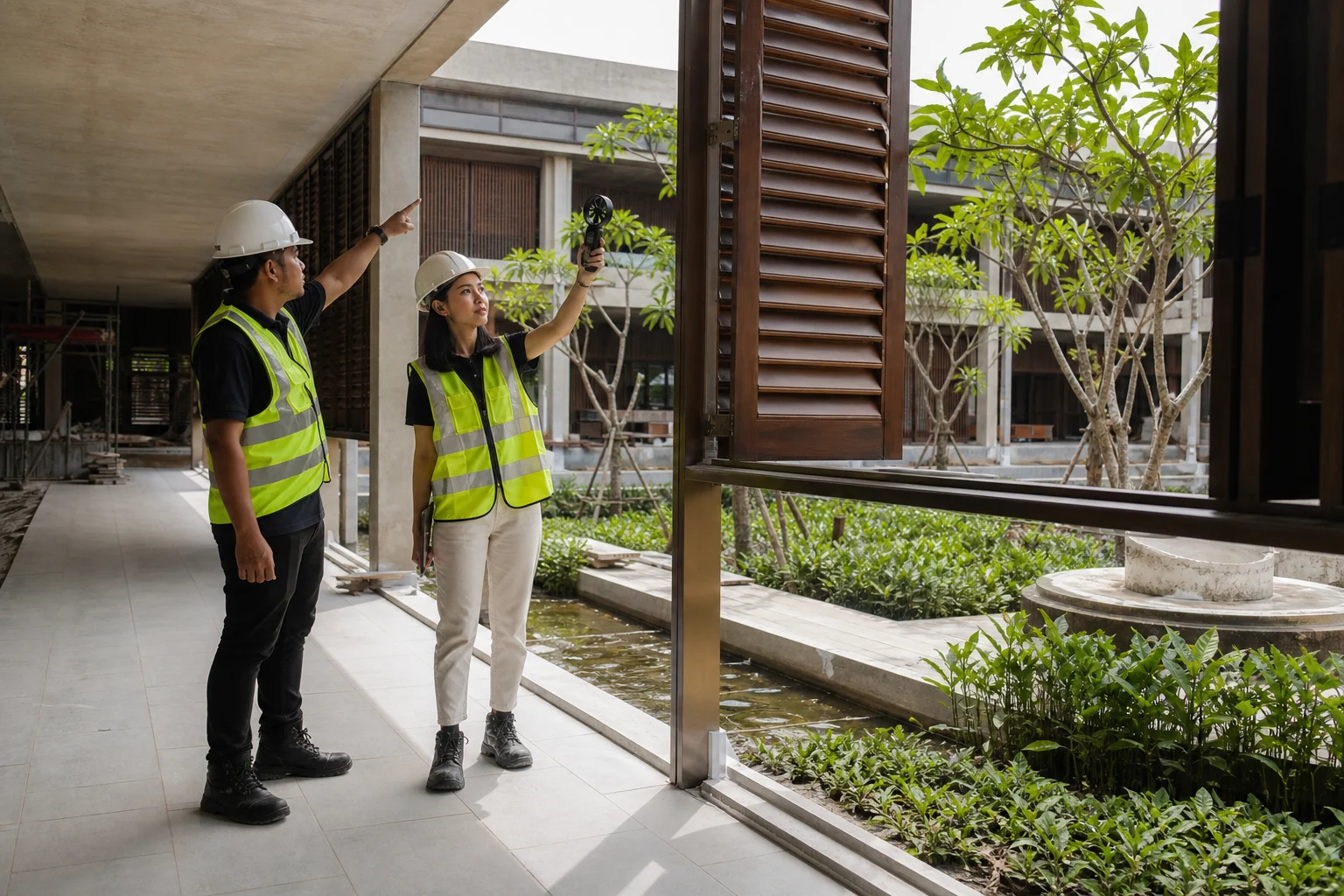
Architect and site engineer measure airflow beside operable timber louvers in a shaded courtyard
Field application / 04

Field observations check whether drawing intent, built detail, and operating reality still agree.

How support scales

Focused enough to move. Broad enough to see consequences.

A narrow question may need one workshop and a marked-up record. A long appointment may need recurring reviews as architecture, facade, services, cost, and operations converge.

  1. 01

    Focused review

    A defined question, one evidence pass, and a review record.

  2. 02

    Design sprint

    Several viable options compared before one direction is selected.

  3. 03

    Stage guardian

    Recurring checks that preserve climate intent through coordination.

Frame a suitable engagement